Between Perfection and Unease
When Erwin Olaf took his first photographs in the early 1980s, the international photographic landscape was undergoing profound change. On the one hand, a new freedom of manners and mores was emerging: a more liberated, provocative, and playful sexuality found its privileged spaces in discos and clubs, and its models and witnesses among their regulars – musicians, actors, fashion designers, artists, photographers, those ‘night butterflies’ of whom Olaf himself considered himself a part. On the other hand, photography was gradually moving away from the street and from documentary practice to enter universities, academies, galleries, and museums: it was no longer limited to recording reality, but was beginning to stage it and to engage openly in dialogue with the other arts. These were the years of Robert Mapplethorpe, Peter Hujar, Anton Corbijn, and Nan Goldin, but also of Jeff Wall, Cindy Sherman, Sandy Skoglund, and Gregory Crewdson.
It was within this climate that Olaf, born in Hilversum in 1959 and who died in Groningen in 2023, developed his own visual language. He began as a photojournalist documenting nightlife, but soon transformed the image into a constructed scene, controlled down to the smallest detail. His interest focused on individuals and groups situated at the margins of so-called normality. “I wanted to focus on groups who were outside of ‘normal’ society”, he stated. He added: “What’s normal? I’m still asking myself that”. The question thus became one of the guiding threads of his artistic research: who determines what is normal and what is not?
Courtesy of
Paci Contemporary Gallery (Brescia – Porto Cervo, IT)
From his early black-and-white series to Chessmen, with which he won the Young European Photographer of the Year award in 1988, Olaf developed an increasingly elaborate form of photography, in which references to reality gave way to the construction of autonomous worlds.The set became a stage, and every element – bodies, clothing, hairstyles, furnishings, make-up, and lighting – was studied with an almost cinematic precision. Photography no longer documented an event: it invented one, while allowing something profoundly human to emerge.
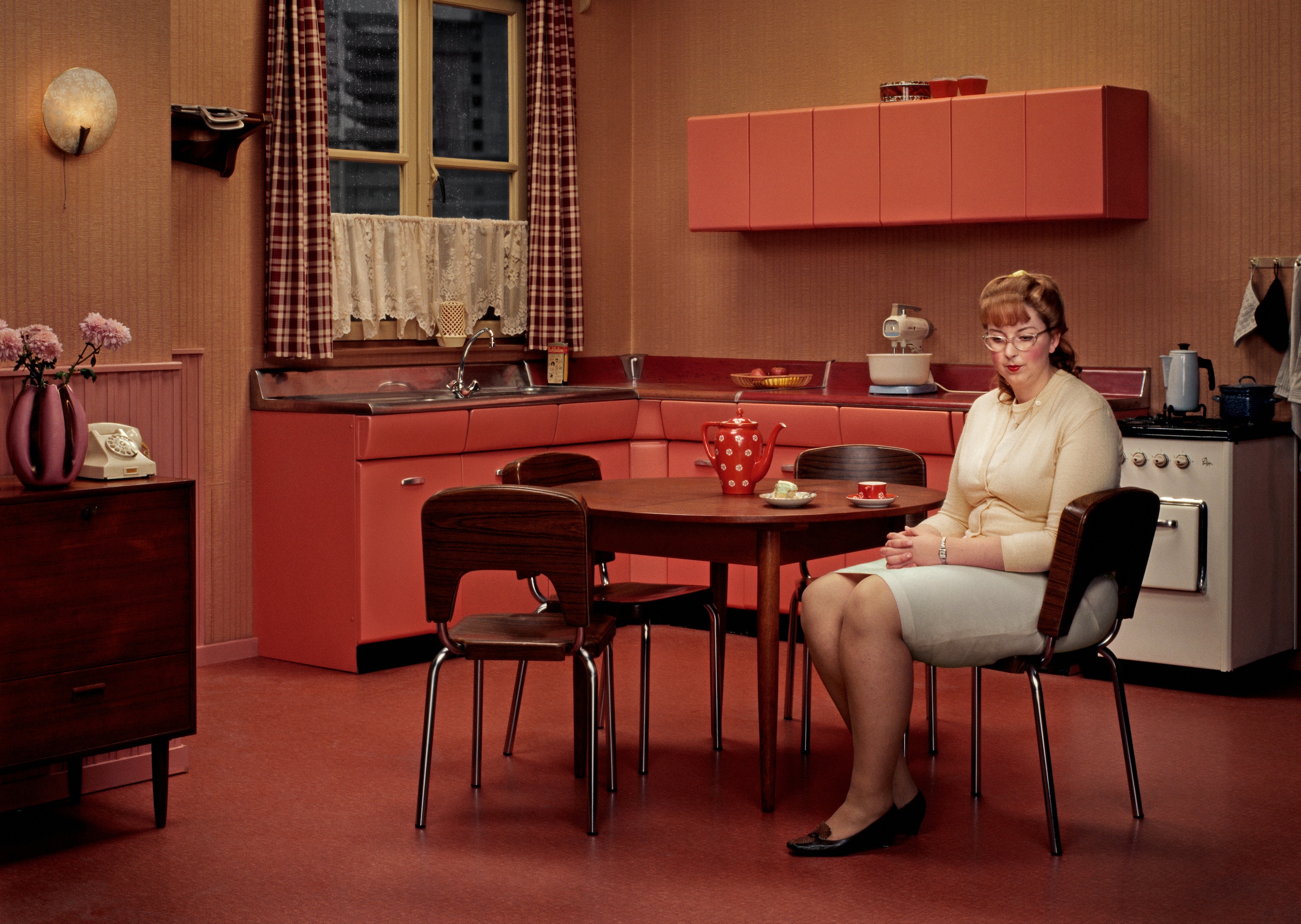
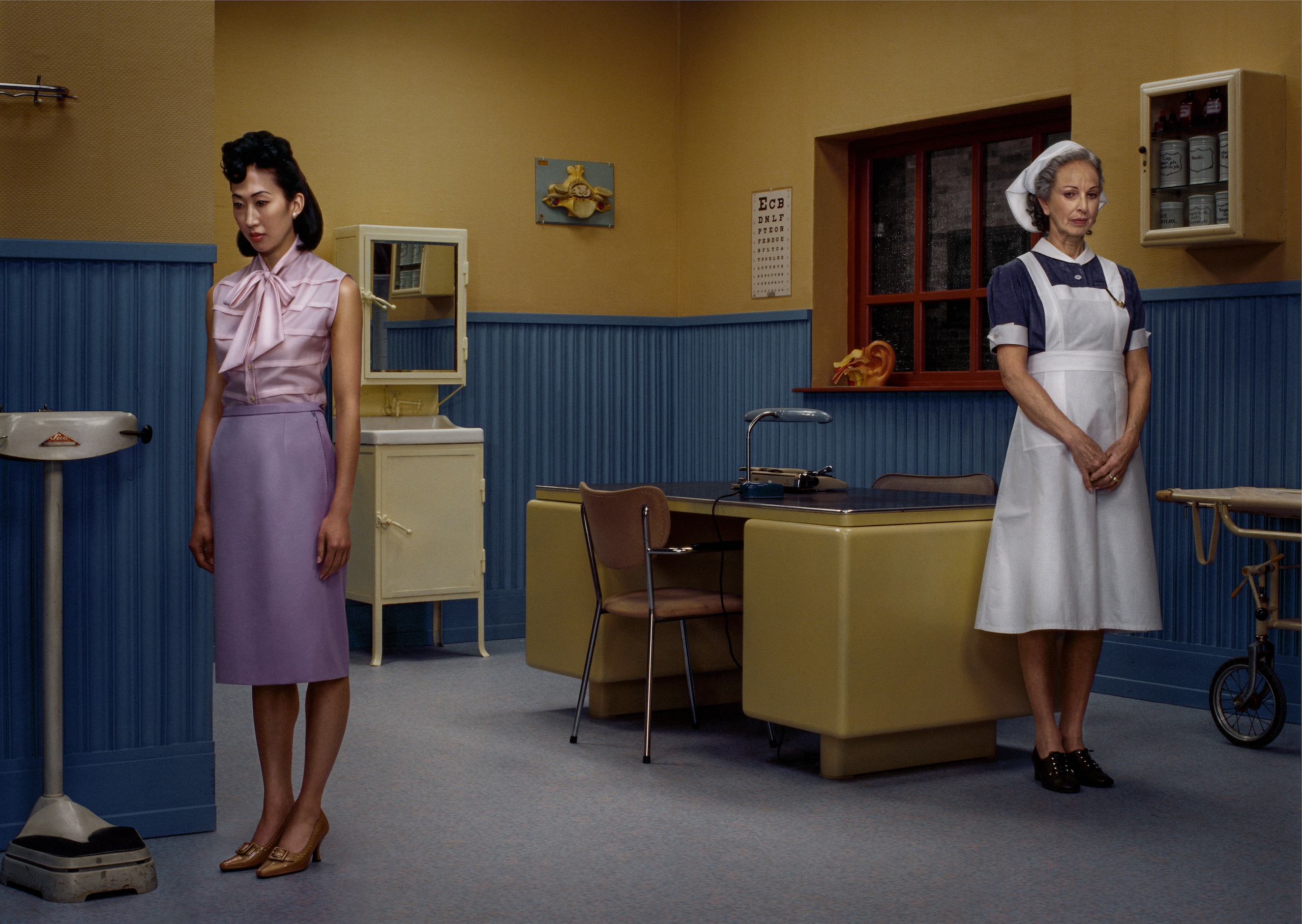
An important turning point came in 2004 with Rain, followed in 2005 by Hope and in 2007 by Grief. These three series marked the beginning of a new phase. The images took on a cinematic dimension and appeared to be fragments of a larger story, whose beginning and ending remain unknown to us. Olaf was particularly interested in that suspended moment ‘between action and reaction’, between what has just happened and what is about to happen. The result is a series of enigmatic scenes, seemingly ordinary yet impossible to interpret completely.
A hairdresser and an elderly woman face each other, yet it is impossible to know what they have said to one another; a girl leaves a gym while another watches her suspiciously; a female student and a professor find themselves alone in a classroom. The settings are often empty, while the figures look away or are photographed from behind. The viewer is thus transformed into an observer invited to formulate questions without ever being given answers. Atmosphere matters more than narrative: it is a suspension of time and space, a sense of solitude and lack of communication that brings Olaf close to the imagery of David Lynch.
The dialogue with painting becomes increasingly evident. In Rain and Hope, references to Norman Rockwell and, above all, to Edward Hopper emerge, with his interiors inhabited by isolated figures unable to communicate. In later series, such as Berlin, Shanghai, and Palm Springs, Olaf also looked to twentieth-century European painting and to the traditions of New Objectivity and Magical Realism. His photographs thus seem to be constructed on the boundary between reality and metaphysics: orderly, rigorous images, yet permeated by enigmas and symbols, from the balloons of Berlin to the closed eyes of Shanghai, and finally to the American flags of Palm Springs.
The body also remains at the centre of his artistic research. This is not merely an aesthetic concern: the body becomes the place through which an individual’s identity and the relationship between the person and society are expressed. Even when concealed by clothing, it continues to tell the story of an era, a way of being, a condition. It is this attention to the individual, combined with the ability to transform every scene into a suspended and ambiguous image, that makes Erwin Olaf’s world so recognisable: a meticulously constructed photography that, precisely through its perfection, leaves room for uncertainty, desire, and questioning.
“One big shift had to do with the invention of Photoshop the new craftmanship. I wanted to do something that was clearly fiction and would not be possible without this tool”.
“We were in between action and reaction. It was like the moment just between you hear the boom of an explosion, and before you can say, ‘What was that’? That moment. I realized I was the wrong person to address the larger issue, directly – I don’t photograph the boom. And I don’t even photograph the moment after it. But I like the moment between action and reaction. This was an interesting discovery for me, which led to the series Rain (2004) and Hope (2005) and others that followed: ‘Ah, you can photograph the moment in between’. And in fact, this gives you a very open story to work with”.
Read more on the hard copy